Comic Style Pop Art Girls: Building Visual Narratives with Retro-Pop Design Resources
The Visual Language of Comic Pop Art
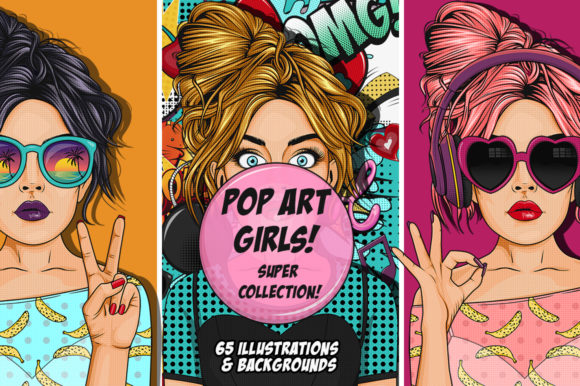
Comic style pop art draws from a rich tradition of bold imagery, halftone textures, and expressive character design. The Comic Style Pop Art Girls collection exemplifies this aesthetic by combining classic comic-book visual cues with contemporary digital illustration techniques. The result is a set of assets that feel both nostalgic and fresh, suitable for projects ranging from social media graphics to editorial layouts.
What makes comic pop art immediately recognizable is its reliance on high-contrast color palettes, sharp outlines, and emotional exaggeration. The girls in this collection carry those traits naturally: wide eyes, dynamic poses, and outfits that pop against patterned backgrounds. When you work with these illustrations, you are essentially tapping into a visual shorthand that audiences already understand intuitively. That instant recognition can be valuable in marketing, branding, and content creation where first impressions matter.
What the Collection Contains and Why It Matters
Understanding the contents of a design resource helps you evaluate its fit for your workflow. This collection includes four distinct pop art girls, each rendered at 12″x18″ (3600px x 5400px) at 300dpi with transparent PNG backgrounds. That resolution is substantial enough for print applications such as posters, flyers, and magazine spreads, while the transparency gives you freedom to layer them into composite compositions without clipping issues.
Character Elements and Expressive Details
The girls are not presented as isolated figures. The kit also contains five pairs of glasses and three hand-arm elements, allowing you to modify expressions and gestures. This modular approach matters because static characters can feel repetitive. By swapping eyewear or repositioning arms, you create variation across a campaign or series of posts without needing to commission new illustrations. For social media managers and small business owners who produce content regularly, that adaptability saves both time and budget.
Typography and Speech Elements
Comic art relies heavily on text as a visual element. The collection includes five popular decorative comic-style words with all surrounding elements presented both together and individually, plus six speech and thought bubbles. These are not afterthoughts; they are compositional tools. Speech bubbles direct the viewer's eye, establish reading order, and convey tone. Having them as separate layered elements means you can position them exactly where your layout demands, resize them without degradation, and color-match them to your palette.
Decorative Accents and Backgrounds
The kit also includes 18 miscellaneous design elements: arrows, bubble gum, headphones, and other thematic accents. These small assets often make the difference between a generic composition and one that feels intentionally styled. Additionally, twelve 12″x12″ backgrounds in JPG format provide halftone patterns and comic book collage textures in various bright colors. Halftone patterns are a signature of pop art, referencing the printing techniques of vintage comics. Using them as backdrops instantly communicates the aesthetic without requiring you to recreate those patterns from scratch.
Technical Specifications and Practical Implications
Every file in this collection is saved at 300dpi. For print designers, that is the standard resolution for professional output. At 3600px by 5400px, the individual girl elements offer enough pixel data to print at sizes well beyond the listed 12″x18″ if needed, though some slight interpolation may occur at extreme enlargements. The PNG format with transparent backgrounds means you can drop these assets into Adobe Photoshop, Affinity Designer, Canva, or even web-based editors without dealing with white boxes or masking headaches.
The smaller elements, such as music notes at 3.5″x4″ (996px x 1200px), are proportionally scaled for use alongside the larger characters. This consistency matters when you are building a cohesive layout and do not want to manually rescale every accent piece to match proportions.
A consideration worth noting is the JPG format of the backgrounds. Unlike the PNG characters, these are raster images with compression. For digital use, the quality is perfectly acceptable. However, if you plan to apply heavy editing or extreme scaling to the backgrounds, you may prefer to convert them to a lossless format within your workflow. The rich colors and collage-style compositions in these backgrounds, though, are designed to work as finished backdrops, so extensive manipulation is often unnecessary.
Real-World Use Cases Across Different Creators
The best way to evaluate any resource is to imagine it in active use. Here are several scenarios where this collection fits naturally.
Social Media Content Creators and Influencers
Instagram story backgrounds, TikTok thumbnails, and Pinterest pins all benefit from high-contrast, visually dense imagery. A comic style pop art girl with a speech bubble and halftone background can stop a user's scroll. Because the assets are pre-rendered at high resolution, you can resize them for square, vertical, or horizontal formats without losing clarity. The decorative words and arrows also help direct attention to calls-to-action or punchlines.
Small Business Owners and Branding
A boutique clothing store, a music studio, or a beauty brand might use these illustrations in email newsletters, window posters, or packaging inserts. The retro-pop aesthetic reads as playful and confident. By swapping the glasses and arm elements, you can create a signature character for your brand that appears across touchpoints without looking repetitive. The 300dpi resolution also ensures that printed materials remain crisp.
Educators and Workshop Facilitators
Classroom materials, presentation slides, and workshop handouts often need visual hooks to engage learners. Pop art characters can illustrate concepts, demonstrate emotions, or simply add visual energy to otherwise text-heavy documents. The speech bubbles are particularly useful for quotes, dialogue prompts, or thought exercises. Since the backgrounds include collage patterns, you can also use them as creative prompts for art or design classes.
Hobbyists and Digital Scrapbookers
Not every project is commercial. Hobbyists who create digital scrapbooks, fan art, or personal blogs will find the modular elements freeing. The ability to combine different glasses, arms, bubbles, and backgrounds into unique compositions encourages creative experimentation. Because the files are organized and labeled, even someone with basic Photoshop or Canva skills can produce polished results.
Workflow Integration and Composition Tips
Integrating these assets into an existing workflow is straightforward if you plan your layers. Start with a background from the JPG set, then place your character PNG above it. Use the transparent layers to position speech bubbles and decorative words. The hierarchical structure of the kit, where elements are provided both together and individually, means you can decide whether to use a pre-composed word graphic or build your own combination from the individual pieces.
One practical approach is to build a template file with your most-used character pose, then duplicate it for variations. Swap the glasses, change the arm position, and replace the speech bubble with different text. This method is especially efficient for content calendars where you need multiple posts in a consistent style.
Another technique involves mixing the halftone backgrounds with other textures. The 12 backgrounds in this set are vibrant and self-contained, but you can also layer them with subtle gradients or multiply blending modes to create depth. Because the characters are isolated on transparent PNGs, they will sit cleanly on top of these experiments.
Observations on Aesthetic Consistency and Creative Freedom
A well-designed resource strikes a balance between providing a strong visual identity and allowing room for personal input. The Comic Style Pop Art Girls collection leans toward the former: the characters have a distinct style that carries through all elements. That consistency is an advantage when you need a unified look across a project. However, it also means the assets are not neutral. They come with personality baked in. That works beautifully for playful, energetic, or retro-themed projects but may feel out of place in minimalist or corporate contexts.
Creators who enjoy customization will appreciate the modular components. The five pairs of glasses and three hand-arm elements are small changes that can shift a character's perceived mood. A character with oversized round glasses and a pointing arm reads differently than one with cat-eye glasses and a waving hand. These subtle variations let you fine-tune the emotional tone of a composition without redrawing anything.
The decorative words, such as "POP" or "WOW," are common in comic vocabulary. Having them as separate elements means you can scale them to become the focal point of a layout or tuck them into a corner as an accent. Their bold, stylized typography matches the character art, so there is no visual dissonance.
Considerations for Print and Digital Output
If you are preparing files for print, the 300dpi resolution and PNG transparency are your allies. For web use, you may want to export copies at 72dpi to keep file sizes manageable, especially if you are building pages with multiple high-res images. The original files provide enough data to work from, so downsampling is always an option. Just retain the originals in your archive for any future print needs.
Color matching is another consideration. The backgrounds and characters use bright, saturated hues characteristic of pop art. When printing, ensure your color space is set appropriately (CMYK for offset or digital press, sRGB for inkjet or web). The vibrancy that looks great on screen can shift slightly in print if profiles are mismatched. Running a test print on your intended paper stock is always a wise step.
For digital projects, consider file organization. With over 40 individual assets, keeping them in clearly named folders by category (characters, glasses, arms, words, bubbles, elements, backgrounds) will save time during active projects. The collection's structure already supports this, but your own folder naming conventions can further streamline access.
The Broader Creative Context of Pop Art Resources
Pop art as a movement has seen renewed interest in design circles, partly because of its compatibility with digital media. The bold lines and flat color areas translate well to screens, and the reference to mid-century comic culture resonates with audiences nostalgic for analog media. Resources like this collection lower the barrier to entry for creators who want to use that aesthetic but lack the illustration skills to produce it from scratch.
At the same time, the availability of pre-made assets raises questions about originality and customization. The most effective use of any clip art resource is as a starting point. A designer who combines these characters with original typography, custom color grading, or unique background compositions will produce work that feels personal rather than generic. The modular elements in this kit are designed to facilitate that kind of creative assembly.
For educators and researchers studying visual culture, kits like this also serve as examples of how digital tools preserve and transform traditional art styles. The transition from hand-drawn comic panels to Photoshop-created PNG assets is a significant shift in production methods. Yet the visual outcome still references the same roots. That continuity between old and new is part of what keeps pop art relevant across generations of creators.