Calla Lilly C2c Throw Pattern: A Practical Guide to Corner-to-Corner Crochet
The Calla Lilly C2c Throw Pattern offers a structured yet flexible approach to creating a substantial corner-to-corner crochet blanket. Unlike generic graphghans, this pattern centers on a specific floral motif arranged within a balanced grid, making it suitable for crocheters who want a defined design without improvisation. Whether you are planning a gift, testing your colorwork skills, or building a consistent production workflow for handmade items, understanding how this pattern works from chart to finished fabric is essential.
Understanding the Calla Lilly C2c Throw Pattern Design
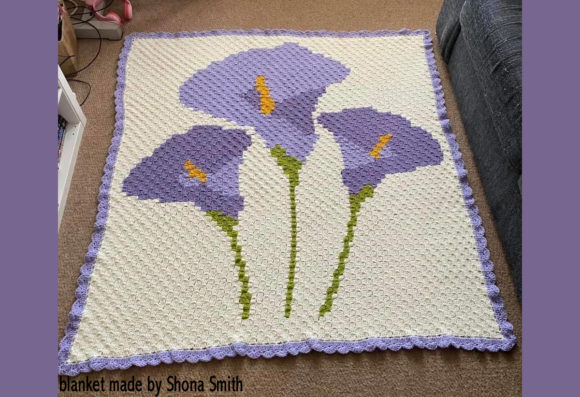
This pattern is built around a 69x69 corner-to-corner grid. Each square on the chart represents one C2C block, typically made of three double crochet stitches and a chain space. The finished throw measures approximately 46 inches square when worked with a 4mm hook and double knit (DK) weight wool yarn, before adding any border. The design features calla lily motifs arranged symmetrically, with background color changes that create contrast and depth.
Because the pattern is square and the chart is symmetrical, it works well for both right-handed and left-handed crocheters. The C2C technique builds the fabric diagonally from one corner to the opposite corner, which means the chart is read diagonally as well. This is different from traditional grid patterns read row by row, so adapting your reading method is a key part of the process.
Where This Pattern Fits in a Broader Project Workflow
Using a charted C2C pattern like this one typically falls in the middle of a larger planning-to-finishing sequence. Before you begin, you need to select yarn colors, check your gauge, and decide whether to add a border afterward. During the crochet phase, the chart becomes your primary reference, and you will refer to it constantly as you increase, work the center, and decrease. After completing the throw, the chart also helps you verify that your color changes align with the intended design, especially if your tension caused slight size deviations.
This pattern can be part of a repeatable process if you make multiple throws for sale or gifts. Once you have established your color palette and hook size, the chart serves as a template you can reuse indefinitely. It also integrates well with other tools such as row counters, stitch markers, and digital chart readers if you prefer to work from a tablet or printed sheet.
How to Read the Calla Lilly Corner-to-Corner Crochet Chart
The 69x69 grid contains 4,761 individual cells. Each cell is either a background color or a design color. In C2C crochet, you work diagonal rows, each row adding one more block until you reach the longest diagonal at row 69, then you decrease back to the opposite corner. The chart is typically read from the bottom right corner upward, but you can orient it however you prefer as long as you maintain diagonal consistency.
For efficient reading, number the diagonal rows on your printed chart. Each diagonal row corresponds to one round of increases or decreases. The numbering helps you track your place without counting blocks repeatedly. Below is a partial example of how the numbering works for the first several diagonals, showing row number, block count, and the color key for that diagonal.
Numbered Chart Reference for the Calla Lilly C2c Throw Pattern
The following is a simplified numbered representation of the first 12 diagonal rows. Use this as a template for numbering your full 69x69 chart. Each row is listed with its number, block count, and a summary of color placement. The full chart contains 137 diagonal rows total (69 increase + 69 decrease).
- Row 1 – 1 block: Background color (BG)
- Row 2 – 2 blocks: BG, BG
- Row 3 – 3 blocks: BG, BG, BG
- Row 4 – 4 blocks: BG, BG, BG, BG
- Row 5 – 5 blocks: BG, BG, BG, BG, BG
- Row 6 – 6 blocks: BG, BG, BG, BG, BG, BG
- Row 7 – 7 blocks: BG, BG, Design (D1), BG, BG, BG, BG
- Row 8 – 8 blocks: BG, BG, D1, D1, BG, BG, BG, BG
- Row 9 – 9 blocks: BG, BG, D1, D1, D1, BG, BG, BG, BG
- Row 10 – 10 blocks: BG, BG, D1, D1, D1, D1, BG, BG, BG, BG
- Row 11 – 11 blocks: BG, BG, D1, D1, D1, D1, D1, BG, BG, BG, BG
- Row 12 – 12 blocks: BG, BG, D1, D1, D1, D1, D1, D1, BG, BG, BG, BG
For the full 69x69 chart, print the grid and write the diagonal row number along the edge. Start at row 1 in the corner and increase the number by one each diagonal until you reach row 69. Then continue numbering from row 70 to row 137 for the decrease section. This structured numbering system eliminates guesswork and speeds up your crochet rhythm.
Materials and Gauge Considerations
Using a 4mm hook with DK wool yarn produces a dense but drapeable fabric. The 46-inch square size is generous for a throw or lap blanket. However, your finished size will vary with your tension, hook size, and yarn weight. If you crochet tightly, your throw may be smaller, requiring a border or a larger hook. If you crochet loosely, expect a wider piece. Always make a gauge swatch with at least 10 C2C blocks square to confirm your block size before starting the full chart.
The total yarn usage is under 1000 grams, which is economical for a project of this size. Depending on your color choices, you may need approximately 600–700 grams of background color and 200–300 grams of design colors. Weigh your yarn before starting and note that wool yarn can felt slightly with handling, which may affect stitch definition.
Preparing Your Yarn and Tools
Wind your yarn into manageable balls or cakes before beginning. Because C2C involves frequent color changes, having small, tangle-free yarn cakes will save you time. Place each color in a separate container or bag to prevent tangling as you turn the work. Use stitch markers to mark the beginning of each diagonal row if you find it helpful, especially during the increase phase when the row length grows quickly.
Print your chart on A4 or letter paper and place it in a clear sheet protector. Use a dry-erase marker to track your row number directly on the plastic. This method is reusable and lets you see your progress at a glance. Alternatively, use a digital chart reader app that highlights the current row.
Workflow for Crocheting the Calla Lilly Throw
Begin at the corner indicated on your chart. Work diagonal increases using the standard C2C technique: chain 6, work 3 double crochet in the fourth chain from hook, turn. For each subsequent increase row, chain 6, work 3 double crochet in the fourth chain, slip stitch to the chain space of the previous block, chain 3, work 3 double crochet in the same chain space, and continue across the diagonal.
As you work, refer to your numbered chart diagonal by diagonal. For example, if diagonal row 7 shows four background blocks and three design blocks, you will make the color changes at the precise positions indicated. Carry unused yarn loosely along the back of the work, or cut and rejoin if the color gap is more than a few blocks. Weaving in ends as you go saves time later.
When you reach row 69, you will have the longest diagonal. From this point, decrease by skipping the final chain 6 start at the beginning of each row. Instead, slip stitch across the last block and begin the row with a chain 3. Continue following the chart in reverse diagonal order until you finish at the opposite corner.
Quality Control During the Process
Check your block size consistency every 10 diagonal rows. Measure across the diagonal from corner to corner. If your blocks are growing or shrinking, adjust your tension before continuing. Also verify that your color changes match the chart. A single misplaced block in C2C is visible because of the diagonal construction, so catching errors early prevents frogging large sections.
If you discover a mistake, you can usually correct it by dropping down a few blocks rather than removing the entire row. C2C fabric is forgiving for partial corrections if you are comfortable with a crochet hook and a tapestry needle.
Adapting the Pattern for Different Uses
The 46-inch square is ideal as a throw, but you can adjust the size by changing your hook and yarn. Using a 3.5mm hook with sport weight yarn creates a smaller, denser piece suitable for a baby blanket or wall hanging. Using a 5mm hook with worsted weight yarn yields a larger throw around 52–56 inches square. The chart itself remains the same; only the block size changes.
You can also use this pattern as a learning tool for C2C colorwork. Because the calla lily motif repeats symmetrically, you can practice reading diagonal charts without the complexity of an asymmetrical design. Once you are comfortable, you can apply the same numbered chart method to other C2C patterns.
Adding a Border After the Chart
The pattern does not include a border, but adding one is straightforward. A simple single crochet border in background color frames the throw and hides any uneven edges. Work 1 single crochet in each block edge along all four sides, with 3 single crochet in each corner. For a wider border, add a round of half double crochet or a shell stitch. The border adds approximately 2–4 inches to the finished dimensions, depending on your choice.
If you are making multiple throws for a production run, standardizing your border approach ensures consistent sizing. Block the finished throw before adding the border to relax the stitches and even out tension differences.
Long-Term Use and Care
Wool yarn throws benefit from gentle hand washing and laying flat to dry. Over time, the C2C fabric holds its shape well because the block construction distributes weight evenly. If you plan to use the throw as a decorative piece, avoid direct sunlight to prevent fading of the design colors. Store the throw folded rather than hung to prevent stretching.
The numbered chart remains useful even after the throw is complete. If you ever need to repair a damaged section, you can refer back to the chart to match color placement exactly. Keep a digital or printed copy with your project notes for future reference.
Practical Summary for Crocheters
The Calla Lilly C2c Throw Pattern is a well-structured design that rewards careful preparation and consistent technique. By numbering your chart diagonals, checking your gauge, and managing your yarn colors efficiently, you can complete this 46-inch square throw with confidence. The pattern fits naturally into a crochet workflow that includes planning, execution, finishing, and long-term care. Whether you are making one for yourself, as a gift, or as part of a product lineup, the combination of a defined chart and adaptable materials makes this a reliable project to return to again and again.